FLEXIBLE PACKAGING SOLUTIONS
We design flexible packaging structures for sugar, dry goods, and rice, prioritizing yield per roll, line efficiency, and sustainability for high-volume products with tight margins.
 Single-layer PE films and high-performance laminates for higher yields per roll
PE and cPP structures compatible with high-speed VFFS lines
Recyclable single-material options for circular economy goals
For high-volume products with tight margins, every packaging decision has a direct impact on profitability. Yield per roll, packaging line efficiency, and logistics cost per unit are variables that are continuously measured and optimized.
Litoplas works with companies in the sugar, dry goods, and ingredients sectors in Colombia and Central America, developing solutions that balance technical performance, production efficiency, and sustainability.
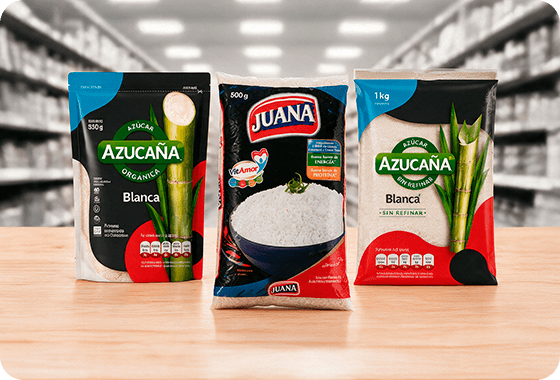

For high-turnover products with low unit margins, the number of packages per roll has a direct impact on the cost per unit. Reducing thickness without compromising mechanical properties is a concrete way to optimize costs.

Sugar, flour, grains, and rice are highly hygroscopic. Packaging with an insufficient barrier causes caking and shortens the shelf life before the date indicated on the label.

Packaging for products such as sugar, flour, grains, and rice must withstand the demands of filling, storage, handling, and transportation. A structure with adequate mechanical strength helps maintain the integrity of the packaging throughout the entire distribution chain.

Retail chains are pushing for more sustainable packaging. Companies need options that improve recyclability without significantly increasing the per-unit packaging cost.
Sugar, flour, and salt are high-density, high-turnover products for which material yield per roll and moisture barrier performance are critical factors.
Sugar:
– High-performance single-layer PE packaging for higher yield per roll on high-speed production lines.
– High-performance laminates for packaging with improved visual appeal in retail settings.
Flour and dry foods:
– High-performance LLDPE films capable of reducing thickness without compromising mechanical properties.
– Very high-performance PE/PE laminates for improved appearance at the point of sale.
Rice, grains, and legumes require packaging with good moisture barrier properties and sufficient mechanical strength for stacking and logistics in medium- and high-weight packages.
– High-performance LLDPE films for packages ranging from 500g to industrial-sized 25kg formats.
– PE/PE laminates for premium-looking packages in modern retail channels.
– Compatibility with high-speed VFFS lines for various package weights and product densities.
Thickness Reduction with High-Performance PELLDPE films allow for reduced thickness without compromising mechanical properties, resulting in higher yield per roll and a smaller carbon footprint in logistics.
Single-material with Plaxi HBFor ingredients requiring a medium barrier, single-material PE structures with Plaxi HB are compatible with conventional mechanical recycling streams.
Single-layer PE is the option that offers the highest yield per roll and the lowest cost per unit, making it suitable for high-turnover sugar in the institutional channel. The high-performance laminate provides added rigidity, a better moisture barrier, and a better printing surface, making it the right choice for the retail channel.
Premature caking is generally caused by an insufficient moisture barrier or a poor seal on the packaging line. A technical evaluation of the material’s WVTR and the sealing process identifies the source of the problem.
Plaxi technology is a proprietary optimization developed by Litoplas and applied to BOPP structures that simultaneously improves the material’s body, optical properties, and moisture barrier properties.
In many cases, yes, especially on VFFS lines where the only adjustment required is the sealing temperature. For flowpack and wickett processes, a preliminary technical evaluation is essential.
Please fill out our contact form, indicating your industry, product type, estimated volume, and any special requirements. Our technical and sales team will contact you as soon as possible.
Tell us about your project, and our team will help you find the right solution.
Al hacer clic en “Aceptar”, usted autoriza que las cookies se guarden en su dispositivo para mejorar la navegación del sitio, analizar el uso del mismo y ofrecer una mejor experiencia de navegación.
