Search

FLEXIBLE PACKAGING SOLUTIONS

Ice Cream Packaging

We design flexible packaging structures for ice cream, combining sealability at low temperatures, water vapor barrier properties, and high-definition visuals for each subcategory.

Single-layer and double-layer BOPP film for ice cream with high-definition graphics

Structures with a WVTR barrier to prevent frostbite

Mechanical strength verified for temperatures ranging from -18 to -25°C

Technical support from the specification phase through production
Let us know what you need, and a sales representative will contact you.

The cold chain begins with packaging

Ice cream products share a requirement not found in other categories: the packaging must function properly at subzero temperatures throughout the entire distribution chain. Cold sealability, mechanical strength at low temperatures, and water vapor barrier properties are critical factors that determine the quality of the product when it reaches the consumer.

Litoplas works with ice cream manufacturers in Colombia and Central America, developing flexible packaging solutions tailored to the thermal profile of each product.

Technical Challenges in Ice Cream Packaging

Sealability at low temperatures

Ice cream is packaged at subzero temperatures. The packaging material must seal properly under these conditions—an improper sealing temperature can cause the product to warp or result in leaks during distribution.

Water Vapor Barrier (WVTR)

Products are susceptible to the formation of ice crystals due to the migration of water vapor from the outside. A high WVTR leads to freezer burn, deterioration of texture, and a loss of organoleptic quality before the expiration date.

Mechanical Strength at Subzero Temperatures

Many plastic materials become brittle at sub-zero temperatures, causing breakage during logistics and in freezing equipment. The material must maintain its mechanical properties within the product’s temperature range of -18 to -25°C.

Optics and Print Quality

Ice cream brands compete in a market where the appearance of the packaging directly influences purchasing decisions. Color accuracy and print sharpness on BOPP materials are factors that affect the perception of the brand’s quality on store shelves.

Our Ice Cream Packaging Solutions

Ice Cream Packaging

Ice cream packaging requires materials that can be sealed at subzero temperatures, have good optical properties for high-definition printing, and exhibit stable mechanical strength at low temperatures. BOPP is the dominant material in this subcategory due to its stable mechanical properties at low temperatures and its excellent printability.

Popsicle and single-serve ice cream:

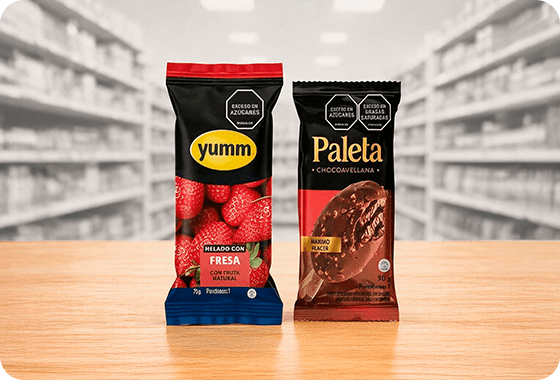
– Single-layer BOPP films for individual popsicle packaging, offering sealability at low temperatures and high-definition printing.
– Double-layer BOPP films for premium ice cream, providing greater packaging rigidity and improved moisture barrier properties—particularly important for products with chocolate coatings.

Multipack formats and bulk packaging:

– PE films for multipack packaging where mechanical stacking strength is the critical factor.
– Compatibility with automatic packaging lines operating at subzero temperatures for high production speeds.

Sustainable packaging for ice cream

Thickness Reduction in BOPP for Ice Cream

High-performance BOPP films allow for optimized material usage by reducing thickness while maintaining the mechanical and sealability properties required for ice cream packaging.

This approach helps increase yield per roll and reduce plastic consumption per packaged unit, without compromising the packaging’s functionality during processing, storage, and distribution.

Material Efficiency Combined with Technical Performance

Sustainability in ice cream packaging also begins with using materials more efficiently. Optimizing the structure allows for a balance between mechanical performance, sealability, and material consumption, in accordance with the specific needs of the product and the packaging process.

This approach enables the development of solutions that prioritize packaging functionality while moving toward a more efficient use of resources.

Frequently Asked Questions

Why is BOPP the standard material for ice cream?

BOPP retains its mechanical properties at subzero temperatures without becoming brittle; it has an excellent printing surface for high color fidelity, and its moisture barrier is sufficient for most ice creams. The dual-layer version provides greater rigidity and a stronger barrier for premium products.

Freezer burn occurs when water vapor from the environment migrates through the packaging into the frozen product, forming ice crystals that alter the texture and flavor. A material with a low WVTR prevents this migration. The airtightness of the seal is equally critical: a micro-leak has the same effect as a high WVTR.

Plaxi technology is a proprietary optimization developed by Litoplas and applied to BOPP structures, which simultaneously improves the material’s body, optical properties, and moisture barrier properties.

Please fill out our form, indicating your industry, product type, estimated volume, and any special requirements. Our technical and sales team will contact you as soon as possible.

Ready to design your next packaging?

Tell us about your project, and our team will help you find the right solution.