FLEXIBLE PACKAGING SOLUTIONS
We design flexible packaging structures for agrochemicals and OTC pharmaceutical products, ensuring that each solution meets technical requirements for chemical barrier properties, mechanical strength, and industry regulations.
PE laminates and recyclable tri-laminates for agrochemicals
Oxygen- and Moisture-Barrier Structures for OTC Pharmaceuticals
Compliance with INVIMA and ICA standards and contact regulations
Technical support from the specification phase through production
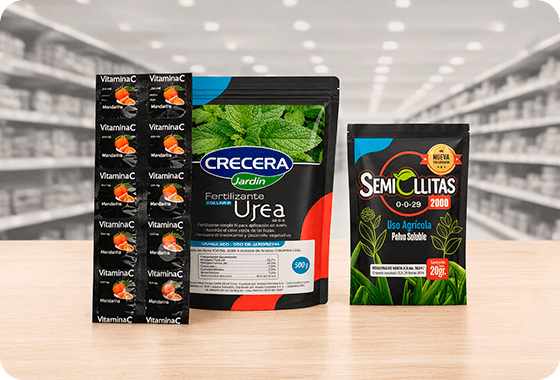
Packaging for agrochemicals and OTC pharmaceutical products requires rigorous technical specifications to protect the contents, facilitate safe handling, and meet the demands of each application.
In these categories, correctly selecting materials, structures, and barrier properties is key to maintaining product integrity and reducing risks during storage, transport, and use. Therefore, packaging should not be evaluated solely on the basis of cost, but also in terms of performance, safety, and responsibility.
Litoplas works with companies in the agrochemical and OTC pharmaceutical sectors in Colombia and Central America, developing flexible packaging solutions that meet the technical and regulatory requirements of each product, with structures validated for chemical resistance, functional barrier properties, and compatibility with the active ingredients in the product.

Packaging for agrochemicals and over-the-counter (OTC) pharmaceutical products must meet high performance standards to protect the contents, maintain their integrity, and withstand storage, transportation, and use conditions.
Packaging for agrochemicals must be compatible with formulations that may interact with the materials used in the packaging. Proper specifications help preserve the integrity of both the packaging and the product throughout its shelf life.
Seal integrity is critical in packaging for agrochemicals and OTC pharmaceuticals. The packaging must remain airtight during filling, storage, transportation, and handling to reduce the risk of leaks or contamination.
Some agrochemicals and over-the-counter (OTC) pharmaceutical products may be susceptible to oxidation. In these cases, selecting a formulation with adequate barrier properties helps protect the active ingredients and maintain product stability.
Packaging for agrochemicals and OTC pharmaceuticals must comply with the regulatory, labeling, and traceability requirements applicable to each product and target market. Material specifications must take these requirements into account from the development stage onward.
Packaging for agrochemicals must withstand demanding handling, stacking, and distribution conditions. A structure with adequate mechanical strength helps prevent punctures, deformation, and damage that could compromise the seal.
Each subcategory has specific technical requirements. Here are the solutions Litoplas develops for each one:
Extruded snacks combine three critical requirements into a single material: a moisture barrier to maintain crispness, an oxygen barrier to prevent rancidity in oil-containing products, and mechanical strength to withstand logistics without transferring impact to the fragile product.
Primary Focus:
-Conventional BOPP laminates for high-turnover snacks with a standard shelf life.
-A differentiated solution using Plaxi technology that optimizes visual appeal, freshness, and material thickness for brands seeking to stand out on the shelf.
-Made of cPP or BOPP for manual or automatic Wicket-style processes.
Secondary Focus:
-Made from locally collected post-consumer PE (rPE) for brands with active circular economy commitments.
Sustainability in packaging for agrochemicals and OTC pharmaceuticals requires balancing technical performance, product safety, and efficient use of materials. Therefore, each packaging design must be evaluated based on barrier requirements, strength, and compatibility with available recycling systems.
Trilaminates designed with a focus on recyclability can provide a functional oxygen barrier for sensitive agrochemicals, reducing reliance on aluminum-based structures when the application allows. Their performance and compatibility must be evaluated based on the waste management system of the target market.
In agrochemicals with lower oxygen barrier requirements, high-performance PE structures can allow for a reduction in thickness while maintaining the required mechanical and chemical resistance. This helps reduce material consumption per packaged unit.
In OTC pharmaceutical products that require protection against oxygen, structures incorporating EVOH can provide barrier properties without necessarily relying on aluminum laminates. Its inclusion should be determined based on the product’s technical requirements and the structure’s design.
Chemical compatibility is evaluated by exposing the material to the product under controlled conditions and verifying any changes in strength, barrier properties, and integrity. Litoplas assists with the selection and validation of the structure prior to its implementation.
Packaging for agrochemicals must comply with the regulatory requirements applicable to the product, its labeling, and its marketing. In Colombia, the ICA regulates the registration of chemical pesticides for agricultural use and the entities involved in their manufacture, packaging, and distribution.
Packaging for OTC pharmaceutical products must be evaluated based on material compatibility, stability conditions, and the regulatory requirements of the target market. INVIMA considers the interaction between the product, the packaging system, and the packaging materials as part of the stability evaluation.
The choice of format depends on the type of product, weight, filling process, and conditions of use. Options include bags, doypack-style packaging, and roll stock for automated lines.
Our technical team can assist you with material specification, chemical validation, and regulatory compliance for your product and target market.
Al hacer clic en “Aceptar”, usted autoriza que las cookies se guarden en su dispositivo para mejorar la navegación del sitio, analizar el uso del mismo y ofrecer una mejor experiencia de navegación.